
Bubbles so small, they never leave the water
A paddle-wheel aerator splashes oxygen in; physics takes it right back out. Oxyniti shears air into bubbles hundreds of times thinner than a human hair. At that size they stop rising, stay suspended, and transfer oxygen with far less loss to the atmosphere — day and night.
- <200 nm Bubble diameter
- ~450 Span one human hair
- 10,000× Gas-to-water contact area
- 24 / 7 Day and night operation
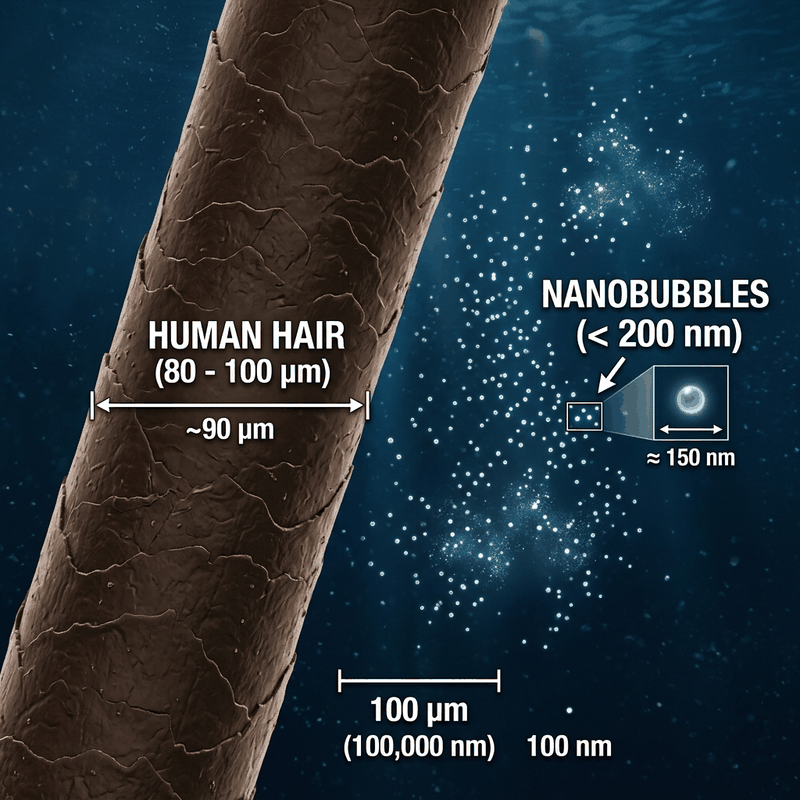
How small a nano-bubble actually is
Shrink an air bubble far enough and it stops behaving like a bubble. It no longer rises to the surface, and it no longer loses its oxygen to the air.
- 80–100 µm A human hair, across. About 90 µm is typical.
- ~2 mm A bubble from a paddle wheel or diffuser — roughly twenty hairs wide.
- <200 nm An Oxyniti nano-bubble. About 450 of them fit across a single hair.
Illustration, not to scale. A typical human hair is 80–100 µm across; individual hairs range from 17 to 181 µm.
Three things stop working the way you expect
A nano-bubble is not just a smaller version of an ordinary bubble. Below roughly a micron, three separate effects turn over at once — and together they are the whole reason the approach works.
They stop rising
Buoyant lift falls away with the cube of a bubble's radius, while the drag holding it back falls only in proportion to it. Below about a micron the arithmetic tips over: buoyancy loses, random thermal motion in the water takes over, and the bubble simply goes where the water goes.
They carry far more surface
Oxygen can only cross where air touches water, and the contact area a given volume of air carries rises as its bubbles get smaller. Shear the same litre of air from 2 mm bubbles down to 200 nm and the surface available for transfer multiplies roughly ten thousand times.
They refuse to merge
Nano-bubbles carry a negative surface charge, so they push each other apart instead of coalescing into big bubbles that would rise and burst. That charge is what keeps the plume fine — and keeps it down in the water column where the fish are.
Where the bubbles end up
If they never rise and never merge, the obvious question is where they go. They do not pop. The oxygen inside crosses into the water and the bubble shrinks around it until there is nothing left to give — which is the whole point. The bubble is the delivery mechanism; dissolved oxygen is the product.
The air inside is under real pressure
Surface tension squeezes a 200 nm bubble to roughly fifteen times atmospheric pressure. The harder a gas is pressed against water, the faster it dissolves into it — so a nano-bubble pushes its oxygen into solution with a force a millimetre-scale bubble simply cannot apply.
They last longer than the theory says
On the textbook arithmetic alone, a bubble that small and that highly pressurised should disappear almost at once. Measured in practice it does not, and the negative surface charge is the leading explanation. That gap between the theory and the measurement is why the effect carries through the night instead of the first few minutes.
Water can only hold so much oxygen
Aeration is not filling an empty container. Water has a fixed appetite for dissolved oxygen, and that appetite shrinks as the water warms — at exactly the time of year your fish are breathing hardest.
Set against a danger zone below 3 mg/L, a pond at 35 °C is working on a thin margin. That is why it matters how much of the air you inject actually dissolves, rather than how much of it you inject.
- 20 °C9.1 mg/L
- 25 °C8.3 mg/L
- 30 °C7.6 mg/L
- 35 °C7.0 mg/L
Maximum dissolved oxygen that fresh water can hold at sea level. Salt water holds roughly a fifth less at the same temperature, and altitude lowers it further.
From pond water to dissolved oxygen, in four steps
The unit sits at the pond edge and runs continuously. There is no chemistry and nothing to dose — it takes in the water you already have, and puts the air back in a form the water can hold on to.
Draw and shear
The unit draws pond or tank water and injects air through a nano-shear chamber, generating very large numbers of bubbles under 200 nanometres across.
Infuse the whole water column
The resulting nano-bubble plume spreads through the water column — not just the surface — raising dissolved oxygen everywhere fish live, rather than only at the point of aeration.
Hold it for longer
Neutral buoyancy keeps bubbles suspended rather than rising and bursting immediately, buffering dissolved oxygen through the highest-risk night-time hours.
Dissolve, instead of escaping
Because nano-bubbles are incredibly small, their surface-area-to-volume ratio is massive compared to regular bubbles. This means almost all the air inside the bubble is in direct contact with the surrounding water. This massive contact area, combined with the fact that they don't rise to the surface, gives the oxygen the perfect opportunity to fully dissolve into the water rather than escaping into the atmosphere.
Compared with conventional aeration
Conventional paddle-wheel and diffused-air aeration produce millimetre-scale bubbles that rise and burst within seconds, so much of the injected oxygen never fully dissolves. Because nano-bubbles do not rise and burst the same way, more of the injected air has the opportunity to transfer into solution before it is lost.
| Attribute | Conventional aeration | Oxyniti nano-bubbles |
|---|---|---|
| Bubble diameter | Roughly 1–3 mm | Under 200 nm |
| Behaviour in water | Rises and bursts within seconds | Neutrally buoyant — stays suspended |
| Where the oxygen goes | Much of it escapes back to the air | More of it transfers into solution |
| Coverage | Strongest at the surface, near the aerator | Through the whole water column |
| Contact area per litre of air | Baseline | Around 10,000× greater |
| Overnight | DO falls once algae stop producing oxygen | Buffered by bubbles still held in the water |
About the bubbles themselves
How long do the bubbles actually last?
Long enough to matter overnight, which is when it counts. Because they neither rise nor merge, nano-bubbles persist in the water far longer than millimetre bubbles that are gone in seconds — and that is what carries dissolved oxygen through the pre-dawn hours when a pond is most at risk.
Will the water look different?
Briefly. A fresh plume reads as a faint milky cloud near the unit, then clears as the bubbles disperse through the pond. The bubbles themselves are far too small to see individually — what you can see is the density of them.
Take it further
- See how this applies to aquaculture
- Oxygenation for RAS and biofloc
- View the OXY-Nano range
- Estimate the impact on your pond
Book a free demo and we will measure the difference on your own water, before you pay anything.
Contact Oxyniti